

Nigeria is Training Doctors For The World
The Health Workforce Brain Drain Crisis and the Case for Retention as National Policy
Issued by: St Tamandu Marine Patrol | RC 7458 | www.santatamandu.org
Reference: STM/ADV/HLT/004/2026 | March 2026
Addressed to: Federal Government of Nigeria, Federal Ministry of Health, National Assembly, and the Nigerian Public
PREAMBLE
ST Tamandu Marine Patrol issues this position paper as part of its ongoing civic advocacy programme on issues of national development and public welfare. It addresses a crisis at the intersection of healthcare delivery, economic policy, and national human capital: the accelerating emigration of Nigeria’s trained health professionals, and the urgent opportunity before the government to make retention a central pillar of national health strategy.
Nigeria is not short of talented health professionals. It trains them at considerable public expense across universities and teaching hospitals in all six geopolitical zones. The problem is not production. A 2025 peer-reviewed study published in the International Journal of MCH and AIDS put the challenge clearly: the country is producing health professionals for the world at a rate that is leaving its own citizens with an increasingly thin and overstretched workforce to serve one of the most complex public health environments on the continent.
THE SCALE OF THE CRISIS
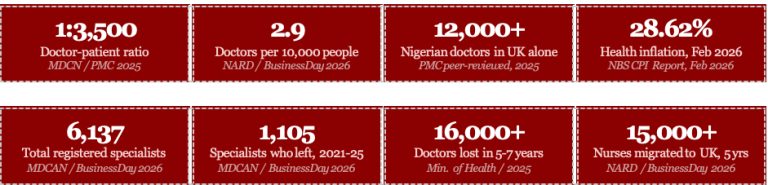
The numbers on the stat panel above are not projections. They are the current documented state of the Nigerian health workforce, drawn from the Medical and Dental Council of Nigeria, the National Association of Resident Doctors, the National Bureau of Statistics, and peer-reviewed research published within the last twelve months. They describe a system under severe and worsening strain.
Nigeria had 74,543 registered doctors for a population of approximately 218 million people in 2022, a doctor-patient ratio of 1:3,500 (MDCN, cited in PMC 2025). By October 2025, NARD reported that the situation had deteriorated further. With approximately 240 million people and roughly 11,000 working resident doctors, the ratio for that cadre alone had reached 1:9,083. The NBS Consumer Price Index for February 2026 placed health-sector inflation at 28.62 percent year-on-year, up from 19.58 percent in February 2025, reflecting the cost pressure mounting as a shrinking workforce bears an expanding burden.
MDCAN data, reported by BusinessDay in March 2026, shows that Nigeria has only 6,137 registered specialists, of whom just 3,475 are actively working in hospitals. Between 2021 and 2025, a further 1,105 specialists left the country. Nigeria is not simply losing doctors. It is losing the doctors it can least afford to lose.
The scale of emigration is documented with increasing precision. A 15-year cohort study published in Cureus in November 2025 found that nearly half of Nigerian medical graduates had emigrated within 15 years of qualifying. The Coordinating Minister of Health and Social Welfare, Professor Muhammad Pate, disclosed in 2025 that over 16,000 Nigerian doctors left the country in the preceding five to seven years. NARD and BusinessDay reported in 2026 that over 15,000 nurses migrated to the United Kingdom alone in the last five years, and a 2025 PMC peer-reviewed study confirmed that more than 12,000 Nigerian-trained doctors are currently practicing in the UK.
The pipeline is under pressure, too. Multiple studies across Nigerian medical and nursing schools have found a high propensity for emigration among current students, many of whom have begun planning their exit before they qualify. The brain drain is not only a current crisis. Without intervention, the future of Nigerian healthcare is being depleted in real time.
WHY THEY LEAVE
Nigerian health professionals who emigrate are not abandoning their country. They are making rational decisions in the face of conditions that the evidence documents clearly. The Cureus cohort study published in November 2025 identified the primary drivers as excessive and unregulated working hours, low and irregular remuneration, limited professional development, poor infrastructure, and weak institutional support.
The working hours data is particularly stark. NARD has reported that Nigerian resident doctors work an average of 106.5 hours per week, with surgical residents averaging over 122.7 hours weekly. These are not sustainable working conditions by any clinical or humanitarian standard. In September 2025, Dr. Femi Rotifa, a resident surgeon at Rivers State University Teaching Hospital, died while on call duty, in circumstances widely attributed by his colleagues and reported by Nigeria Health Watch to exhaustion from extended working hours. His death was not unique. It was documented.
- Remuneration: The salary differential between Nigeria and destination countries is significant and consistently cited as the foremost driver of emigration in published research. A doctor in the United Kingdom earns multiples of a Nigerian public sector physician’s salary, in a stable currency, with reliable payment.
- Working conditions and infrastructure: Public hospitals frequently lack basic supplies, functional equipment, reliable power, and clinical support that health professionals need to practice safely and effectively. Practicing medicine in chronic under-resourcing is professionally demoralizing and personally dangerous.
- Career development: Opportunities for specialization, research, and continuing professional development are significantly more available in destination countries. The PMC 2025 study identified this as a consistent and growing driver, particularly among junior doctors.
- Security and quality of life: Healthcare workers and their families share the broader security and economic pressures facing Nigerian society. The combination of personal insecurity, currency instability, and infrastructure deficits makes staying a genuinely difficult choice, not a passive default.
WHAT THE EVIDENCE SHOWS WORKS
The government has engaged in this crisis. The Federal Ministry of Health and Social Welfare launched a Health Labor Market Analysis in 2025, supported by partner organizations, aimed at evidence-based workforce planning. The Nigeria Health Workforce Registry, introduced as an institutional planning tool, is a foundation that deserves to be built upon. A Medical Brain Drain Bill was introduced in the National Assembly in 2023, proposing to withhold full medical licenses from newly qualified doctors for a period to restrict emigration. While the intent reflected genuine concern, the approach attracted significant criticism from health professionals, civil society, and legal experts who argued that restricting movement without improving conditions was unlikely to retain talent and could reduce the attractiveness of medicine as a career for the next generation of Nigerian students.
International experience points toward a different and more effective approach. Countries that have made meaningful progress on health workforce retention have done so through integrated packages: salary reform matched with working conditions improvement, regulated hours, funded specialization pathways, bilateral agreements with destination countries that create structured exchange rather than one-way emigration, and diaspora engagement frameworks that turn brain drain into a distributed national resource. Retention is a systems problem that requires a systems response.
The question is not how to stop doctors from leaving. The question is how to make Nigeria a place where staying is a credible, sustainable and professionally rewarding choice. That is a different question, and it has different answers. The evidence shows those answers are achievable.
OUR RECOMMENDATIONS
ST Tamandu Marine Patrol respectfully calls on the Federal Government of Nigeria, the Federal Ministry of Health, and the National Assembly to prioritize the following as the foundation of a credible national health workforce retention strategy:
- Develop and fund a National Health Workforce Retention Plan with clear targets, timelines, and budgetary commitments, treating remuneration, working conditions, infrastructure, and career development as an integrated package rather than isolated interventions.
- Legislate and enforce maximum working hour regulations for resident doctors and all health workers, consistent with NARD’s October 2025 directive. Mandatory rest periods after extended call duties must be enforced across all public tertiary hospitals, not merely committed to on paper.
- Substantially review public sector health professional remuneration to meaningfully narrow the gap between Nigerian salaries and those available in destination countries and introduce structured retention incentives for professionals in underserved and rural postings.
- Invest in the infrastructure of public teaching hospitals and primary health care facilities, including reliable power, essential equipment, medical supplies, and digital health tools, to ensure that professionals who remain can practice to the standard their training prepared them for.
- Pursue bilateral agreements with the United Kingdom, United States, Canada and other major destination countries on ethical health worker recruitment and structured professional exchange, creating pathways for Nigerian health professionals in the diaspora to contribute through mentorship, telemedicine and periodic return.
- Fully activate and continuously update the Nigeria Health Workforce Registry as a live planning and retention tool, ensuring that workforce distribution trends, emigration data and deployment gaps inform policy and budget decisions at both federal and state levels.
- Develop a formal Nigerian Health Diaspora Engagement Programme, creating a structured relationship between the government and the estimated tens of thousands of Nigerian-trained health professionals abroad, drawing on their skills, networks and resources in support of health system strengthening at home.
CLOSING STATEMENT
Nigeria has the human capital. The doctors, nurses, and specialists trained in this country are among the most capable health professionals in the world. The United Kingdom, the United States, and Canada know this. Their health systems depend on it. The question before the government is whether Nigeria will build the conditions to benefit from its own investment in human talent, or whether it will continue to export that talent at scale while its own citizens face a healthcare system under unsustainable strain.
ST Tamandu Marine Patrol believes the government has both the will and the capacity to act decisively on this crisis. We acknowledge the steps already taken, including the Health Labor Market Analysis and the Nigeria Health Workforce Registry, as evidence of institutional seriousness. We call on that seriousness to be matched with the funding, the legislation, and the sustained political commitment that the scale of this crisis demands. We offer this paper in the spirit of constructive civic partnership and stand with every Nigerian who deserves a functioning, well-staffed health system.
Every doctor who leaves Nigeria carries with them years of training, public investment, and the potential to serve thousands of Nigerian patients across a career. Retention is not a welfare concession. It is a national investment with a direct return measured in lives saved. The evidence shows it is achievable. The will to act is all that remains.
ST Tamandu Marine Patrol | De Norsemen Kclub International, Lagos Chapter | RC 7458 | www.santatamandu.org