
Plateau Must Not Become Normal
A Civic Call for Accountability, Civilian Protection and Justice for the Communities of Plateau State
Issued by: ST Tamandu Marine Patrol | RC 7458 | www.santatamandu.org
Reference: STM/ADV/SEC/005/2026 | 30 March 2026
Addressed to: Federal Government of Nigeria, Plateau State Government, National Assembly, Security Agencies, and the Nigerian Public
ISSUED IN RESPONSE TO LAST NIGHT’S ATTACK
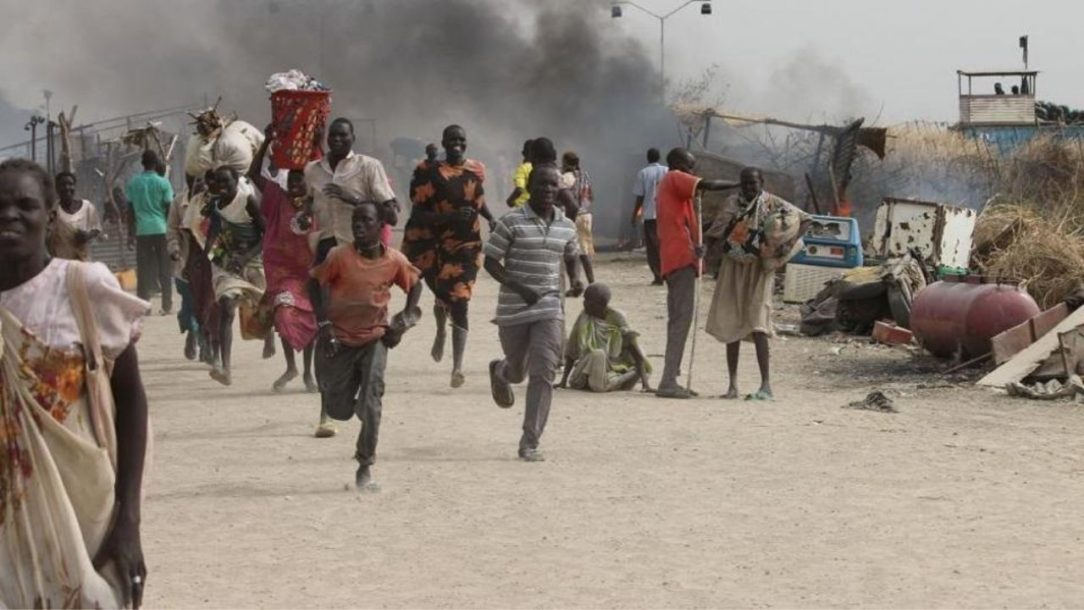
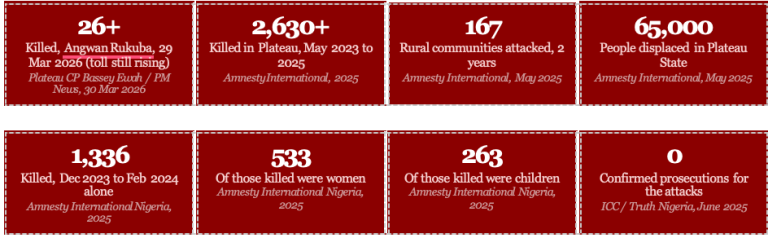
On the night of Sunday, 29 March 2026, gunmen attacked the Gari Ya Waye community in Angwan Rukuba, Jos North Local Government Area, Plateau State. The attack began at approximately 7:50 p.m. Security personnel arrived nearly an hour later. The Plateau State Commissioner of Police, CP Bassey Ewah, confirmed 26 deaths when Governor Mutfwang visited the community on Monday morning. Community leaders and residents placed the figure higher, with Reuters and local media reporting at least 30 killed, and some sources citing 40. The toll was still rising as this paper was written. The Plateau State Government imposed a 48-hour curfew on Jos North with immediate effect. Governor Caleb Mutfwang condemned the attack as barbaric and unprovoked. The University of Jos suspended its examinations. And the rest of Nigeria woke up on Monday morning and moved on.
ST Tamandu Marine Patrol will not move on. We issue this position paper on 30 March 2026, the morning after the Angwan Rukuba attack, because the Plateau State crisis has reached a point where civic silence is itself a form of complicity. This is not the first attack on a Plateau community in recent years. It is not the second. It is not the tenth. The pattern is documented, the scale is documented, the failure of accountability is documented, and the cycle continues because not enough Nigerians outside Plateau State are treating it as their problem. It is their problem. It is our problem. It is a Nigerian problem.
ST Tamandu Marine Patrol has previously issued position papers on the Boko Haram insurgency in the northeast, on kidnapping for ransom, and on the duty of care owed to NYSC corps members. The Plateau crisis belongs in that same conversation, on the same terms: communities are being killed, security is failing to protect them, no one is being held accountable, and the cycle continues. This paper calls for that cycle to be broken.
A PATTERN THAT CANNOT BE CALLED COINCIDENCE
The numbers above are not from opposition politicians or partisan sources. They are from Amnesty International, which documented at least 2,630 deaths in Plateau State between May 2023 and 2025, across 167 rural communities in eight local government areas. They are from the Plateau State Government’s own acknowledgements. They are from verified media reporting going back years. Between December 2023 and February 2024 alone, Amnesty International Nigeria documented at least 1,336 people killed in Plateau State. Of those, 533 were women, and 263 were children. Over 29,000 people were displaced in that two-month window.
The attack on 29 March 2026 is the second consecutive Palm Sunday on which Plateau communities have been massacred. In April 2025, gunmen killed at least 54 people in Zikke village, Bassa LGA, hours after Palm Sunday celebrations. Amnesty International condemned what it called inexcusable security lapses. The University of Jos was not closed then. It has been closed now. The statement condemning the attack has been issued again. The curfew has been imposed again. The pattern is the same. The outcome, for the families burying their dead this morning, is the same.
Across Plateau State, the pattern that Amnesty International and investigative journalists have documented is consistent: communities are attacked at night, frequently for extended periods lasting an hour or more, security forces arrive late or not at all, no arrests follow, no prosecutions follow, and the community is left to bury its dead and wait for the next attack. In June 2025, three men were killed near the Government Secondary School in Kwall, Bassa LGA, approximately a quarter of a mile from a Nigerian military drone base. No security personnel arrived after the incident. The military authorities made no public statement. One LGA chairman, Hon. Dr. Joshua Riti of Bassa, said openly: “You cannot have such attacks happen near a military facility and see no reaction”
THE ACCOUNTABILITY FAILURE AT THE CENTRE OF THIS CRISIS
ST Tamandu Marine Patrol frames this crisis primarily as an accountability failure, because that framing points most directly to what must change. The communities of Plateau State are not being killed because Nigeria lacks the security architecture to protect them. Nigeria has an army, a police force, state security services, local intelligence networks, and a National Security Council. The communities are being killed because that architecture is not being deployed with the speed, consistency, and consequence that the scale and pattern of these attacks demands.
The accountability failure operates at three levels. The first is operational: security forces are not responding to attacks in time to protect lives. In the 29 March 2026 attack, TheCable reported that security personnel arrived nearly an hour after the assault began. Residents placed 36 distress calls to the military during the Christmas 2023 attacks. The reasons for these delayed responses have not been publicly investigated or explained. The second is investigative: despite years of attacks and thousands of deaths, the number of confirmed prosecutions of perpetrators is, by all available reporting, effectively zero. The third is political: the federal response to the Plateau crisis has been characterised by statements of condemnation and assurances of action that have not translated into the structural security investments, prosecutions, and conflict-resolution frameworks the situation requires.
A resident of Maru LGA, Zamfara State, speaking to Amnesty International about a similar pattern of attacks, put it plainly: "The only relationship between us and the government is that they issue media statements after we are attacked and killed. That is all they do. When the next attack comes, they will issue another empty statement." The communities of Plateau State have heard the statements. They are still waiting for the protection.
WHY THIS IS EVERY NIGERIAN’S CONCERN
It would be a mistake to treat the Plateau crisis as a regional or sectarian problem that does not require the attention of Nigerians in Lagos, Abuja, Port Harcourt, or Kano. The crisis in Plateau State is a symptom of a national security failure: the inability of the Nigerian state to protect rural farming communities from organised armed violence. That failure is not confined to Plateau. It is present in Benue, in Zamfara, in Katsina, in the northeast, and in the displacement figures that collectively show over 450,000 Nigerians internally displaced by attacks on farming communities.
The displacement of farming communities has direct consequences for food security. The majority of those attacked and displaced in Plateau State are farmers. Their displacement means their land is not cultivated. Amnesty International warned in May 2025 of a looming humanitarian crisis in Plateau and Benue directly resulting from farmer displacement. A Nigeria that cannot protect its farmers cannot feed itself. The Plateau crisis is a food security crisis in addition to a security crisis, and both demand urgent national attention.
OUR DEMANDS
- The Federal Government must deploy adequate and sustained security resources to Plateau State’s rural communities, with a specific operational mandate to prevent nighttime attacks, respond within minutes rather than hours, and provide a visible deterrent presence in the local government areas where the pattern of violence is most acute.
- The Inspector General of Police and the Chief of Army Staff must publicly account for the security response failures documented across repeated attacks in Plateau State, including the June 2025 Kwall attack that occurred within a quarter mile of a military facility without a security response.
- The Federal Government and Plateau State Government must immediately establish an independent, time-bound investigation into the attacks since December 2023, with a specific mandate to identify perpetrators, build prosecutable cases, and deliver convictions. Zero prosecutions after thousands of deaths is not a law enforcement outcome. It is a law enforcement failure that must be named and corrected.
- The National Emergency Management Agency and the Plateau State Emergency Management Agency must scale up humanitarian support to the 65,000 displaced persons in Plateau State, including those displaced more than once after attacks on IDP camps, with particular attention to women and children who constitute the majority of the displaced population.
- A National Farmer Protection Framework, as called for in ST Tamandu Marine Patrol’s broader security advocacy, must be established to address the systematic targeting of farming communities across the Middle Belt and northwest, combining security deployment, community early warning systems, and the prosecution of those who attack farming communities as a matter of deliberate national policy.
- The Nigerian media and civil society must sustain attention on the Plateau crisis beyond the immediate news cycle. Every attack generates a day of coverage and a week of silence. The communities of Plateau State deserve sustained national attention, not periodic bursts of sympathy that fade before the next attack arrives.
CLOSING STATEMENT
ST Tamandu Marine Patrol acknowledges the Plateau State Government’s condemnation of the 29 March 2026 attack and Governor Mutfwang’s assurances of ongoing efforts to apprehend those responsible. We welcome those assurances and call on the federal and state governments to match them with the operational deployment, investigative seriousness, and prosecutorial follow-through that the communities of Plateau State have been waiting for across years of documented violence.
We also speak directly to every Nigerian reading this paper who has not previously engaged with the Plateau crisis as something that concerns them. The communities being attacked are Nigerian communities. The children being killed are Nigerian children. The farmers being displaced are feeding, or trying to feed, a Nigerian population. Their safety is not a Plateau matter or a Middle Belt matter or a religious matter. It is a Nigerian matter. And a country that tolerates the massacre of its citizens without accountability has accepted something about itself that it should refuse to accept.
Palm Sunday 2025: 54 killed. Palm Sunday 2026: at least 26 confirmed dead, with the toll still rising. Same state. Same season. Same security failure. Same absence of prosecutions. Plateau must not become normal. ST Tamandu Marine Patrol is calling on the Nigerian state and the Nigerian public to make sure it does not.
ST Tamandu Marine Patrol | De Norsemen Kclub International, Lagos Chapter | RC 7458 | www.santatamandu.org


It’s a sad one that happened in Jos on Palm Sunday……It takes all to curb the insecurity situation in our nation and we all hope the govt can find a way to stop these abnormalities that are already becoming normal in our regions.